A man I work with hit eighteen days last month and sent me a screenshot of the counter like a trophy. Two nights later it was back to zero, and the next text was a different man entirely: maybe I am just broken.
He is not broken. He was keeping score of the wrong number.
Compulsive porn use is not a frequency problem you solve by counting days. It is a feeling problem, and the count quietly hides the thing actually driving it. Your brain learned a pathway to the fastest relief in the room, and consistent with what we understand about how the brain adapts, that pathway can be redirected. That is the premise of the work I do with men, and the research this year keeps saying the same thing, in four different voices. After more than 4,100 sessions with over 2,400 men, the pattern is consistent: the men who get free are never the ones who counted the longest. They are the ones who finally stopped counting and started listening.
Why does the urge get worse when you try to stop?
Most men walk in asking the same question: if I really want to quit, why does it feel harder the moment I try? The urge is not random. It is a learned response to a feeling, and the moment you take away the response without addressing the feeling, the feeling gets louder. That is not weakness. That is a nervous system doing exactly what it was trained to do. The men I work with are almost always stronger than the story they tell about themselves, and recognizing this mechanism is the first step out.
Is compulsive porn use really about how much you watch?
A nationally representative US study published this year in Archives of Sexual Behavior found that compulsive porn use and psychological distress, anxiety, depression, and loneliness, are what the authors call trait-like partners. They do not line up as one clean cause and one clean effect, and the research does not tell us which comes first. They travel together. And the two sharpest markers were not how much a man watched. They were whether he felt lonely around his use and distress around it. Consistent with the emerging evidence, the question that matters is not how many days you string together. It is what state you keep reaching into the screen from.
Archives of Sexual Behavior, 2026. The two sharpest markers were emotional, not behavioral.
Why the pain, not why the habit
Gabor Mate spent his career with the hardest addictions, and one line of his has stayed with me for years: the question is never why the addiction, it is why the pain. Addictions, he writes, always originate in pain, and you cannot understand one without asking what relief it provides. The screen is not the disease. It is the painkiller. You can count clean days for a month, but if you never ask what the painkiller was for, the engine underneath keeps running and the count is just a measure of how long you white-knuckled it. That is why I built ARISE around three layers, the neurological, the emotional, and the relational, because each one is a different doorway into the pain the screen is medicating.
Compulsive use and distress travel together. The day-count touches only the screen step and leaves the rest of the loop turning.
Does relapsing mean you failed?
Here is the part the streak culture will not tell you. A 2026 scoping review in Sexual Medicine Reviews looked at the best available treatments for compulsive porn use and reached a blunt conclusion: there is still no standardized, evidence-based protocol, and not one study even measured complete abstinence as the outcome. Sit with that. The serious research on this does not treat a flawless streak as the goal, because that is not how a regulated behavior changes. So a slip is not proof you are broken. It is information. It tells you which feeling, which hour, which trigger still owns you, and that is something you can actually work with. Shame is not.
What works instead of counting days?
None of the men I have watched get free did it by counting. They did it by working the feeling the screen was there to numb.
Be honest about severity first, because this part costs me clients to say. If your use is light and recent, you may not need me at all, and you should run the move below before you pay anyone. If it is already running your nights, and especially if you are noticing that anxiety, depression, or sleep are affected, that is when structured help earns its place, and a professional evaluation for anything else traveling with it is always appropriate.
The move you can do tonight does not fight the urge. The next time it climbs, before you reach, name the feeling underneath it, out loud or on paper: am I lonely, anxious, bored, tired, ashamed? You are not trying to win a standoff. You are answering Mate’s question in real time, why the pain, so you can meet the feeling instead of medicating it. The counter never once asked you that. This does, and it is the actual work.
What is this actually costing you?
I sat across from a man last year, successful by every external measure, who said the truest thing I heard all month: I am not even avoiding people anymore. I just stopped wanting them. That is the cost most men do not say out loud. It was never a number on a screen. It is that the screen is the one connection that asks nothing of you, and the more you lean on it, the more the real thing, the kind that is awkward and uncertain and asks you to show up, starts to feel like too much. A lot of capable men are quietly deciding it is not worth the price. You do not just want to stop a behavior. You want the appetite for real connection back, and the nerve to pay for it. That is the prize, and I have watched ordinary men reach it, not by counting and not because anyone shamed them, but because they finally treated the feeling instead of the frequency.
If this is hitting close to home
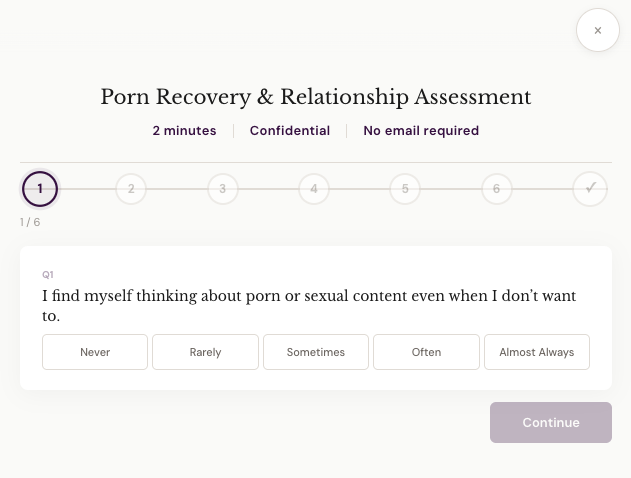
The most useful next step is not a sales pitch. It is a short, completely private self-assessment built around those three layers I mentioned: the neurological, the emotional, and the relational. It shows you which one is actually driving your pattern, so you stop guessing and start working the right thing. We do not do shame and we do not count streaks. We work how the brain and the feeling underneath it actually operate.
Most men have one dominant layer. The free assessment shows you yours in three minutes.
FAQ
Should I stop counting days? Counting can give you early structure, but the research does not treat abstinence as the goal, and the count quietly hides the emotional driver. Track the feeling you use inside, not only the streak.
Does a relapse mean I failed? No. It is data about which state still drives the reach, and that is exactly what you build the next step on.
Is compulsive porn use really tied to loneliness and anxiety? Yes. A 2026 nationally representative study found that compulsive use and distress are trait-like partners that travel together, with loneliness around use as a key marker.
When should I get professional help? If your use is running your nights, affecting your sleep, your relationships, or your ability to focus, a structured program can do what willpower alone cannot. The free assessment is a good first step.
About the author
Jeffrey Ly holds an M.A. in Clinical Psychology with Marriage and Family Therapy training and has conducted 4,100+ sessions with 2,400+ men. He is a clinical consultant, not a licensed therapist, and ARISE is training and education, not therapy or medical care.
Connect with Jeffrey on LinkedIn